
 Industry News
Monday, July 6th, 2026
Detectors play a vital role in industrial CT systems. They primarily convert received X-ray signals into electrical signals. The electrical signals are subsequently filtered and amplified by dedicated signal processing circuits, and finally transmitted to the computer control system via cables.
Industrial CT equipment adopts various types of detectors, mainly including image intensifiers, linear array detectors, and flat-panel digital detectors.
As an outdated traditional digital imaging detector, the image intensifier is a composite device combining an X-ray image intensifier and a digital camera. It presents different grayscale values according to the X-ray intensity of different positions of the tested workpiece.
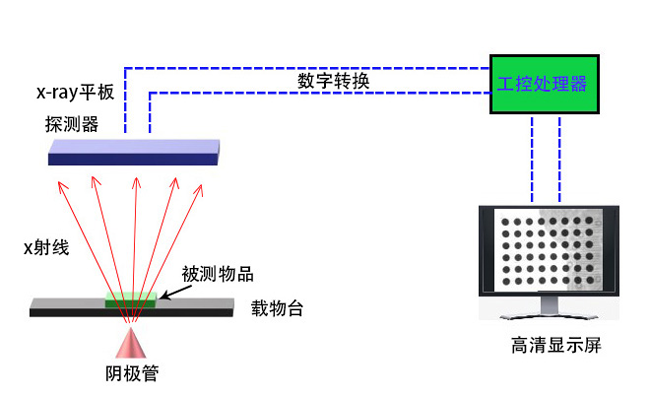
A linear array detector consists of multiple detection units arranged in a linear array, with scintillator materials such as cadmium tungstate (CdWO4) and pixel specifications of 0.2mm and 0.4mm. It features excellent X-ray penetration performance, as the depth of the scintillator along the X-ray direction is unrestricted, enabling most incident X photons to be captured effectively. Meanwhile, it performs well in suppressing X-ray scattering, especially under high-energy conditions, which shortens photon acquisition time. Independent scintillators separated by tungsten or other heavy metal spacers effectively reduce X-ray crosstalk. However, its pixel size cannot be minimized, with adjacent pitch generally larger than 0.1mm, and it is relatively costly, thus mostly configured for high-energy industrial CT equipment
Flat-panel digital detectors are mainly divided into amorphous silicon flat-panel detectors and CMOS flat-panel detectors. As area array detectors, they deliver high imaging efficiency, suitable for real-time or quasi-real-time dynamic DR imaging and direct three-dimensional imaging. Nevertheless, they have inherent limitations including low X-ray detection efficiency, unconstrained scattering and crosstalk, and narrow dynamic range, resulting in poor performance in high-energy scenarios. Area array and linear array detectors are both widely used in systems below 1MeV. For high-energy scenarios that only require internal structural inspection without precise defect detection, area array detectors are also applicable despite relatively low image accuracy.
Due to differences in working principles, various detectors adapt to distinct detection scenarios. Reasonable detector selection should be made according to actual industrial CT application requirements.

 无
无
 集团总部:浙江省衢州市
 +86 152-5150-5981

 微信
微信