
-
CT EquipmentX-Ray EquipmentCT EquipmentX-Ray EquipmentCT EquipmentX-Ray EquipmentX-Ray Source
 Industry News
Monday, July 6th, 2026
Common radiation source types adopted in industrial CT mainly include X-ray machines and linear electron accelerators, collectively referred to as electronic radiation generators. Both devices generate X-rays via broadly identical physical mechanisms, namely bremsstrahlung radiation induced by the abrupt deceleration of high-speed electrons when bombarding target materials. In addition to bremsstrahlung radiation, characteristic radiation may occur when high-speed electrons interact with inner-shell electrons of the target material. The energy of characteristic radiation is correlated with the atomic number of the target material, ranging from several thousand electron volts to tens of kiloelectron volts. Such energy is relatively low compared with the radiation energy applied in most industrial CT inspections, so its influence is generally not required to be specially considered.
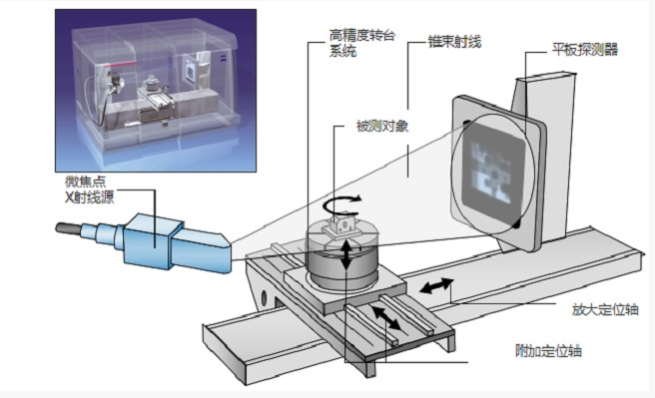
Inside an X-ray machine, electrons emitted by an electron gun are simply accelerated in an electric field. The energy of electrons upon reaching the anode equals the potential difference between the anode and cathode. For the purpose of distinguishing it from X-ray energy units (keV, MeV), the potential difference between two electrodes is conventionally expressed in kV. Both the peak radiation energy and intensity of an X-ray machine are adjustable, and commercially available X-ray machines feature a peak radiation energy range from tens of kiloelectron volts up to 450 keV. Subject to inherent performance requirements of industrial CT, X-ray machines are required to deliver not only an appropriate maximum operating voltage, but also sufficient current intensity, a small focal spot, superior stability and high reliability. Classified by focal spot size, common X-ray tubes include nano-focus X-ray tubes, micro-focus X-ray tubes, small-focus X-ray tubes and conventional-focus X-ray tubes.
By contrast, the acceleration principle of linear electron accelerators is far more complex and varies among different accelerator types. Non-destructive testing linear electron accelerators are categorized into travelling-wave accelerators and standing-wave accelerators. The peak radiation energy of linear accelerators is generally non-adjustable, with a practical applied peak energy range of 1–16 MeV. Although higher energy levels are technically achievable, they are mainly adopted in limited experimental research.
These two types of radiation sources have distinct characteristics and applicable scenarios. X-ray machines provide flexible energy regulation, suitable for various inspection applications that do not require extremely high radiation energy and demand flexible parameter adjustment. Linear electron accelerators can generate high-energy radiation, which is more applicable for inspecting large-sized, high-density and high-value workpieces. For instance, linear electron accelerators are commonly used as radiation sources for detecting high-energy solid propellants in solid rocket motors.

 Group Headquarters::Quzhou City, Zhejiang Province
R&D Center:Wuxi City, Jiangsu Province
Production Bases:Wuhu City(Anhui), Yancheng City(Jiangsu)
Test Base:Chengdu City, Sichuan Province
 +86 152-5150-5981



 prev
prev